
Oyakodon
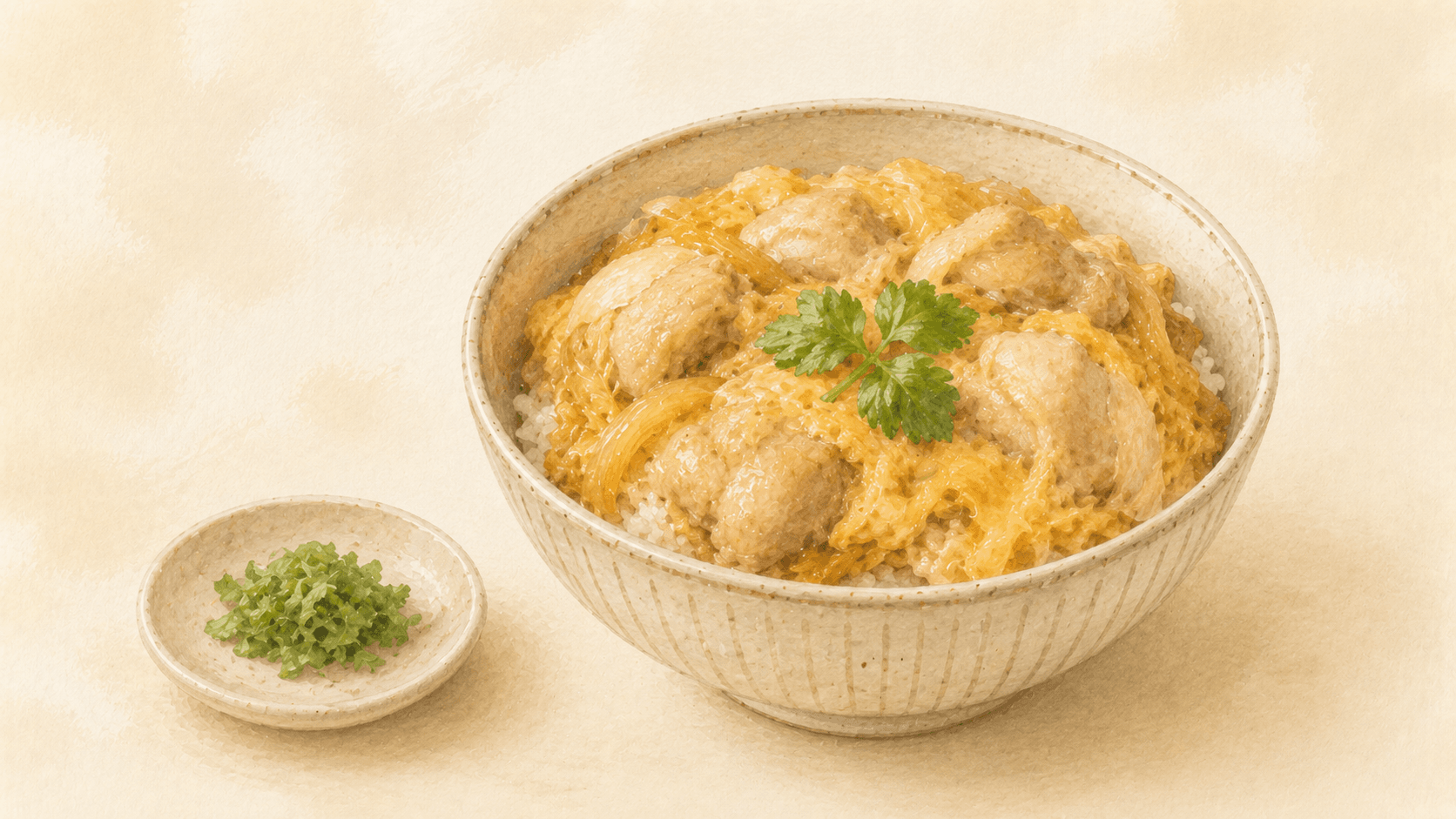
Chicken simmered briefly in a dashi-soy-mirin sauce, then bound with half-set egg and served over rice. The name — parent and child — refers to the deliberate combination of hen and egg in one bowl.
Contents (7 sections)▾
Ingredients
- 250 g boneless chicken thigh — cut into bite-sized pieces
- 3 large eggs
- 1 medium onion — halved and thinly sliced
- 200 ml dashi
- 3 tbsp soy sauce
- 2 tbsp mirin
- 1 tbsp sake
- 1 tsp sugar
- 2 bowls cooked short-grain rice
- Mitsuba or spring onion to garnish
Steps
Make the sauce: Combine dashi, soy sauce, mirin, sake, and sugar in a small skillet or dedicated oyakodon pan (about 20 cm diameter). Stir to dissolve the sugar. The sauce should taste distinctly savory-sweet at this point — this is the tare that will season everything in the pan.
Cook the chicken and onion: Add the sliced onion to the cold sauce and bring to a gentle simmer over medium heat. Cook the onion for 3–4 minutes until it begins to soften. Add the chicken pieces in a single layer. Cook over medium heat for 4–5 minutes, turning once, until the chicken is cooked through to 74°C/165°F at the center of the thickest piece (check with an instant-read thermometer). The cooking liquid will reduce slightly.
Add the egg in two stages: beat the eggs lightly — not fully homogenized; some separation of yolk and white produces a more varied texture. Pour two-thirds of the beaten egg evenly over the chicken and onion, cover, and cook on medium-low. For ordinary (non-pasteurized) eggs, continue until the egg is fully set throughout, with no wet, flowing egg left. For the traditional soft, just-set finish, use eggs pasteurized in the shell (through to the contents) — for everyone, not only high-risk diners; then pour the remaining egg over the top, cover 20–30 seconds, and stop while the surface is just set. Rice or residual heat is texture, not a Salmonella kill step.
Slide over rice and garnish: have the rice ready in a bowl. Tilt the pan and slide the chicken-egg mixture over one side of the rice bowl, allowing it to drape across the rice rather than being scooped. Garnish with mitsuba or spring onion. Eat immediately while hot.
Why this works
Oyakodon is a study in the precision of egg-setting temperature. The final texture of the dish depends entirely on the egg being arrested at the precise moment when the protein network has formed enough to cohere but not enough to expel moisture and tighten. This is not a forgiving window. Egg white proteins begin denaturing at around 60°C; yolk proteins firm from about 65°C. The target for oyakodon is a soft-set where the whites are barely opaque, the yolk has just begun to thicken, and the whole mass holds loosely together without being rubbery.
The two-stage addition of egg is the structural solution to this problem. The first addition of two-thirds of the egg goes in when the sauce is hot and the pan is covered — this sets a foundation layer that bonds with the chicken and onion, creating the structural base of the topping. The second addition goes in when that foundation is still wet, and is given only a short covered time. The result is a top layer that is barely set, almost flowing, which contrasts with the more cohesive layer beneath. The textures are different from each other and from the rice below — this is why oyakodon in the correct state is more interesting than its ingredient list suggests.
Chicken thigh is the correct cut for this preparation. Breast meat cooked in a hot simmering sauce for 4–5 minutes will tighten and dry — the myosin proteins contract at around 65°C, and breast's lower intramuscular fat content leaves little lubrication once the moisture is driven out. Thigh meat, with its higher fat and connective tissue content, stays moist through the same cooking window. The mild collagen in thigh also contributes body to the sauce.
The dashi-soy-mirin-sake mixture is called warishita when made ahead and used as a seasoning base. The balance matters: soy sauce provides the salt and glutamate; mirin contributes sweetness and a faint sake-like aroma; sake adds volatiles that carry during the brief simmer; sugar amplifies the sweetness for a result that is noticeably sweeter than plain soy-simmered chicken. This is deliberate — the sweetness is what makes oyakodon register as comfort food rather than as seasoned protein over rice.
Safety — soft-set egg: Oyakodon's topping is a soft, barely-set egg — some of it left almost flowing, and a runny spoonful poured over at the table is even suggested — so this method does not include a validated step that reliably kills Salmonella, and the residual heat of the rice, the soft look, or the timing are not proof that it is safe. To keep it soft safely, use eggs pasteurized in the shell, through to the contents (heat-treated to destroy Salmonella) or a pasteurized liquid egg product; an ordinary egg that has only been washed, graded, or surface-sanitized — no matter how fresh — is not pasteurized through the contents. Pregnant people, infants and young children, older adults, and anyone immunocompromised should cook the egg through until fully set, or use pasteurized eggs.
Common mistakes
Adding the egg all at once.
Target: Two-stage egg addition — 60 % of beaten egg first, wait 20 seconds, then add the remaining 40 % around the edges.
Why it matters: A single addition cooks uniformly — either fully solid (high heat) or unevenly set (low heat). The two-stage method gives you a stable base layer AND a barely-set silken top layer simultaneously — the textural signature of restaurant oyakodon.
What to do: Beat egg gently (don't whisk to froth). Add the larger portion, let it begin to set, then drizzle the remainder over the top right before plating.
Workarounds:
- For absolute beginners, use 3 eggs and add in 3 stages — easier to control the texture stages.
- For extra-runny finish, save the last 1 tbsp of egg and pour it ON TOP of the assembled donburi at the table.
Overcooking the chicken.
Target: Chicken cut small and simmered until cooked through to 74°C/165°F on an instant-read thermometer — with thin pieces this takes only a few minutes, so it stays juicy.
Why it matters: Raw chicken must reach 74°C/165°F before it is served — the residual heat of the sauce and the rice is not a reliable way to finish it, so don't pull it early counting on that. Keep it from drying out by cutting it small so it comes up to temperature fast, not by undercooking it.
What to do: Slice chicken thin (1 cm pieces) so it cooks quickly, add to the simmering sauce, and cook until it is 74°C/165°F all the way through with no translucent raw centers. Opacity is only a rough cue — confirm the temperature with a thermometer — then add the egg.
Workarounds:
- For tougher cuts, pre-marinate in soy + mirin for 15 minutes — partially pre-seasons and starts tenderization.
Using breast meat.
Target: Boneless skinless chicken thigh only.
Why it matters: Breast dries and tightens during the brief simmer with no recovery possible. Thigh has enough collagen and fat to stay tender and juicy through the entire process.
What to do: Buy boneless skinless thighs. Cut into bite-sized pieces.
Workarounds:
- Only breast available? Brine 30 minutes in 5 % salt water first — adds moisture protection.
Using a pan that's too large.
Target: The standard oyakodon-nabe (single-serving pan) is 18–20 cm diameter. NOT a regular sauté pan.
Why it matters: The pan size determines the depth of sauce and egg. Too large → sauce spreads too thin → uneven egg coverage → impossible to slide onto rice in one piece.
What to do: Buy a small Japanese oyakodon-nabe (cheap, dedicated tool). Or use a small saucepan (18 cm) for the same effect.
Workarounds:
- Have to use a large pan? Make 2 portions in the same pan and divide carefully when plating.
Wrong sauce ratio.
Target: Dashi 100 ml + soy sauce 1.5 tbsp + mirin 1.5 tbsp + sugar 1 tsp per portion.
Why it matters: Oyakodon's sauce is sweeter and lighter than other donburi (gyudon, katsudon). Get it wrong and the dish reads as the wrong donburi.
What to do: Mix sauce ahead. Bring to simmer in the small pan before adding any ingredients.
Workarounds:
- No mirin? Use 2 tbsp sake + 1.5 tsp sugar for approximation.
Cold rice underneath.
Target: Rice at "freshly cooked" temperature — at least 80 °C when serving.
Why it matters: Cold rice drops the temperature of the cooked-to-soft egg, partially "setting" it on the way down. Hot rice maintains the molten texture of the egg, which is the entire point.
What to do: Cook rice to coincide with finishing the chicken+egg. Or pre-warm a bowl of rice in the microwave (30 sec) before topping.
What to look for
- After egg first addition: edges of egg setting, center still visibly wet.
- After egg second addition: surface of second egg layer just beginning to cloud — not opaque, not liquid. The center should wobble slightly if the pan is moved.
- Sliding onto rice: the egg-chicken mass should hold together enough to be moved but not be fully solid.
- On the rice: the egg continues to set from residual heat — this is expected and desired. Serve within 2 minutes of plating.
Chef's view
Oyakodon (literally "parent-and-child rice bowl" — the "parent" is the chicken, the "child" is the egg) is unusual in the donburi (Japanese rice-bowl dishes topped with simmered or fried ingredients) category for how little it disguises. The individual components — chicken, egg, onion, rice — are all visible and intact. There is no sauce that covers everything, no strongly flavored paste, no hiding of textures. What holds the dish together is the restraint of the seasoning: the warishita is present but not dominant, and the quality of the dashi is directly audible in every bite.
The dish appears in Japanese home cooking as often as once a week in many households. Its speed is part of its value — the entire preparation from raw ingredients to plated bowl is under 15 minutes with practice. But speed is a consequence of the design, not the goal. Oyakodon is fast because its cooking logic is tight: every step has a precise reason, and nothing is added beyond what is needed.
Chef Test Notes
Tested with breast meat and thigh side by side. Breast meat was noticeably drier and tighter in the final dish. Thigh meat remained moist and yielded a more cohesive sauce due to the rendered fat.
Tested single egg addition versus two-stage addition. Single addition at medium heat produced a uniform texture that was entirely set before the residual heat of the rice could continue cooking it — no textural contrast. Two-stage produced the desired layered texture.
Tested dashi quality: ichiban dashi produced a clean, bright sauce. Commercial powder produced a functional result but with less nuance. The difference is most noticeable in the egg layer, where the quality of the liquid is most exposed.
Related glossary terms
- Dashi — the foundational broth in the warishita sauce
- Maillard reaction — not directly applicable here, but relevant to understanding why oyakodon intentionally avoids browning the chicken
- Emulsion — the egg-sauce interaction during cooking
Get the essays in your inbox — free
Weekly notes on flavor, fermentation, and food history — the writing behind the Atlas of Flavor. No spam; unsubscribe anytime.