
Osso Buco
This dish features braised veal shanks, enhanced by slow cooking to develop rich flavors and tender meat.
Contents (5 sections)▾
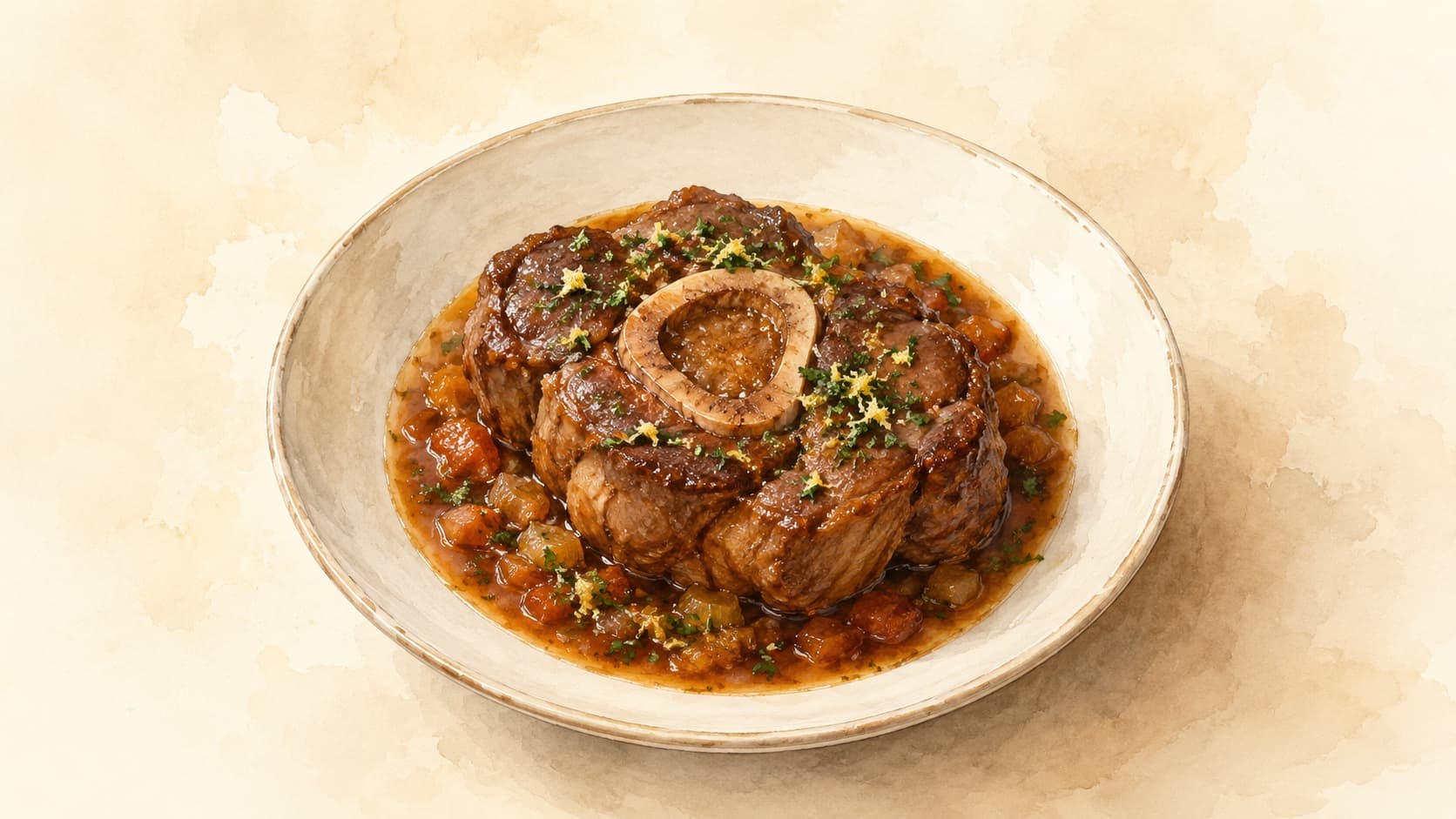
Ingredients
- 4 veal shanks, about 1.5 inches thick
- 1 cup all-purpose flour
- 4 tablespoons olive oil
- 1 onion, chopped
- 2 carrots, chopped
- 2 celery stalks, chopped
- 2 garlic cloves, minced
- 1 cup white wine
- 1 cup beef stock
- 1 can (14 oz) diced tomatoes
- 1 tablespoon fresh thyme
- Salt and pepper to taste
Steps
Preheat oven to 325°F (163°C).
Dredge veal shanks in flour, shaking off excess.
Heat olive oil in a wide heavy skillet over medium-high heat.
Sear veal shanks until browned on all sides, about 6 minutes each.
Add onions, carrots, celery, and garlic; sauté until softened.
Pour in wine and stock; add tomatoes and thyme. Return shanks to skillet.
Cover and braise in the oven for about 1.5 hours, or until tender.
Tools you'll want
- · Digital kitchen scale (gram precision)
Why this works
Osso Buco (literally "bone with a hole" — marrowbone-veal shank cross-cut) relies on the slow braising method (cooking in a covered pan with a small amount of liquid at a low temperature) to break down collagen in the veal shanks. Cooking at a low temperature, around 325°F (163°C), allows the meat to become tender without drying out. The interaction of the wine, stock, and tomatoes creates a complex sauce that enhances the flavor.
The flour coating on the veal shanks helps to develop a crust during searing, which adds depth to the dish. This Maillard reaction enriches the taste and contributes to the sauce's body. The inclusion of mirepoix (onion, carrot, celery) provides a foundational flavor, while fresh thyme adds aromatic notes.
By covering the skillet during braising, moisture is retained, ensuring the meat cooks evenly. The marrow (the soft, fatty tissue inside the bone, scooped out as the classic finish) in the bone melts into the sauce, enriching its flavor and adding a luxurious mouthfeel.
Common mistakes
Skipping or short-cutting the sear.
Target: Deep golden-brown crust on all sides — about 5-6 minutes per side over medium-high heat.
Why it matters: Maillard browning is the foundation of the sauce's depth — melanoidins from the seared crust dissolve into the braising liquid and define the dish's character. No sear = flat, one-dimensional braise regardless of cook time.
What to do: Pat shanks dry, dust lightly with flour. Hot pan, neutral oil. Don't move for the first 4 minutes — let the crust set.
Workarounds:
- Shanks too wet → drain on a rack 15 min first; surface moisture must be gone before searing.
Braising temperature too high.
Target: Oven at 150-160°C (300-325°F), liquid at a bare simmer (small bubbles, not boiling).
Why it matters: High heat causes muscle fibers to contract and squeeze out moisture before collagen has time to convert to gelatin — tough, dry meat. Low slow braising = melting tender.
What to do: Verify oven temperature with a thermometer. Listen — the pot should be quiet, not bubbling vigorously.
Workarounds:
- Stovetop only → lowest simmer with a heat diffuser; cracked lid.
Not allowing enough braising time.
Target: 2-2.5 hours at the right temperature. Test with a fork: should slide in easily.
Why it matters: Collagen-to-gelatin conversion needs time at temperature. Pulling shanks at 60-90 min = tough. The dish has no shortcut.
What to do: Plan for 2.5 hours minimum. Check at 2 hours; if fork meets resistance, continue.
Workarounds:
- Pressure cooker → 45 min high pressure, then 20 min natural release; texture is acceptable, not optimal.
Burning the mirepoix.
Target: Mirepoix (onion, carrot, celery) softened and golden — 8-10 minutes after the shanks come out.
Why it matters: Burnt vegetables make the entire braising liquid bitter. The brown fond from searing should be lifted into the sauce; the mirepoix should add sweetness, not char.
What to do: Drop heat after removing shanks. Stir occasionally. Translucent and slightly golden is the target, not deeply browned.
Workarounds:
- If something burned → deglaze with wine immediately; if liquid tastes bitter, start the braise base fresh.
Skipping the gremolata.
Target: Gremolata at the end — finely chopped parsley + lemon zest + garlic, scattered on each plate.
Why it matters: Gremolata is the dish's traditional finish — it cuts through the rich braised meat and marrow with bright acid and aromatic top notes. Without it, osso buco is heavy on the palate.
What to do: Make fresh at serving time — wilts within minutes.
Workarounds:
- No lemon → use orange zest (Sicilian variation); still works.
Marrow lost during cooking.
Target: Tie shanks with kitchen twine around the circumference to keep the marrow in the bone during braising.
Why it matters: During long cooking, the meat shrinks and the marrow can slip out, leaving the central bone empty. The marrow is one of the dish's prized elements — keep it intact.
What to do: Tie tightly before searing. Cut twine after plating.
Workarounds:
- No twine → arrange shanks vertical (bone-up) in the pot; gravity helps.
What to look for
- The meat should be fork-tender and easily pull away from the bone.
- A rich, thick sauce that coats the back of a spoon.
- Vegetables should be soft but retain some structure.
- The marrow should be visible and slightly oozing from the bone.
Chef's view
Osso Buco is a classic dish from Lombardy, Italy, embodying the region's traditions of slow cooking. It reflects the Italian philosophy of using simple, high-quality ingredients to create profound flavors. The dish is often served with gremolata (a raw mince of parsley, lemon zest, and garlic scattered over each plate at the table), a fresh herb condiment that brightens the rich flavors of the braised meat.
In Italian homes, Osso Buco is a comfort food. It symbolizes family gatherings and the joy of sharing a meal. The technique of braising is practical.
<!-- beginner-glossed v1 -->Get the essays in your inbox — free
Weekly notes on flavor, fermentation, and food history — the writing behind the Atlas of Flavor. No spam; unsubscribe anytime.