
Salmon Ochazuke
Leftover rice and a cup of hot dashi or green tea — ochazuke is the Japanese answer to the question of what to do with cold rice that has dried out. The salmon flakes are cooked, the nori is dry, the broth is hot: everything already done.
Contents (7 sections)▾
Ingredients
- 2 bowls cooked short-grain rice (cold or reheated, about 300 g total)
- 100–150 g cooked salmon fillet — flaked
- 500 ml hot dashi (ichiban dashi preferred; green tea is a traditional substitute)
- 2 sheets nori — torn or cut into strips
- 1 tsp toasted white sesame seeds
- 2 spring onions — thinly sliced
- Wasabi — small amount, to taste
- Sea salt — to taste
Steps
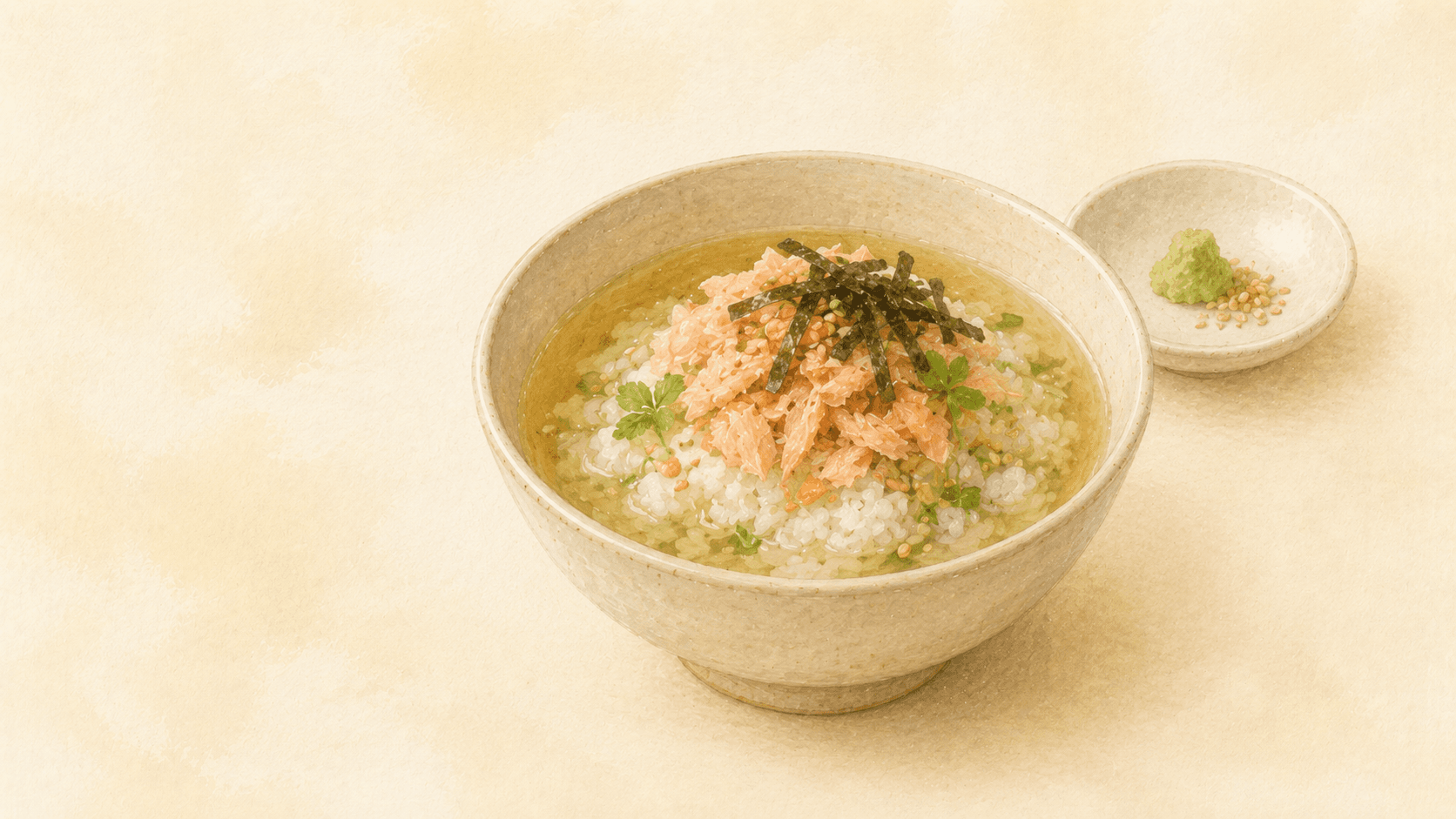
Prepare the bowl: Place cold or reheated rice in a bowl. If reheating, do not overheat — the rice should be warm, not steaming. Flake the cooked salmon over the rice, removing any bones or skin. Add nori strips, sesame seeds, and sliced spring onions. A small amount of wasabi placed to the side is traditional; let the eater mix as desired.
Heat the dashi: Bring dashi to a near-boil in a small saucepan. Season lightly with salt — the dashi should be seasoned but not heavily salted, as the salmon and condiments carry their own salt. Green tea used as a substitute should be brewed at a slightly lower temperature (80°C) to avoid bitterness.
Pour and serve: Pour hot dashi over the rice and toppings at the table, or just before serving. The ratio is a matter of preference — some prefer a wet, soupy texture, others want just enough dashi to warm the rice without flooding it. Eat immediately.
Why this works
Ochazuke works because it asks nothing new of its ingredients. The salmon is already cooked. The rice is already cooked. The nori is already dry. The only act of cooking is heating the dashi — and even that is barely cooking. What ochazuke does instead is thermal assembly: it uses the latent heat of near-boiling liquid to simultaneously warm cold rice, rehydrate the nori, and bloom the volatile compounds in the sesame and spring onion. All of this happens in the bowl, in the thirty seconds between the pour and the first spoonful.
The structural logic of ochazuke depends on the temperature differential between components. Cold rice in contact with near-boiling dashi does not turn to porridge; it warms unevenly and at the surface first, which is the desired result. The innermost grains of rice remain slightly firmer than the outer ones, giving a textural range that straight-heated rice does not have. This gradient is why overheating the rice before adding dashi is a mistake — pre-heated rice receives the liquid uniformly and the texture flattens.
Dashi (the foundational Japanese stock made from kelp and dried fish flakes — the savory base under most Japanese soups and simmered dishes) is the load-bearing element. Its role is not primarily to add volume; it is to deliver umami in a form that penetrates every component in the bowl. Ichiban dashi — the first-extraction broth made from kombu and katsuobushi (dried, smoked, and shaved bonito flakes that smell distinctly of the sea) — carries glutamates from the kombu and inosinate from the bonito, which together produce a synergistic umami effect that is measurably stronger than either compound alone. The salmon provides additional inosinate. The result is a layered umami that builds with each spoonful rather than arriving flat.
Green tea as a substitute for dashi changes the flavor significantly. Tea provides bitterness alongside a lighter vegetal umami from its amino acid content (specifically theanine, which is related to but distinct from glutamate). The traditional ochazuke with tea — the origin of the dish — is subtler and more astringent than the dashi version. Both are correct; they are different dishes using the same assembly method.
Wasabi's role is to cut through the mild richness of the salmon and the starch of the rice. Used sparingly, it adds a sharp volatile note — from the isothiocyanates that form when wasabi's cell walls are broken — that dissipates quickly in the hot dashi. This is why wasabi is placed to the side rather than stirred in: the eater controls the timing and intensity of that sharpness.
Common mistakes
Poor-quality dashi.
Target: Fresh ichiban dashi (kombu + bonito) — not instant powder.
Why it matters: Ochazuke is a simple dish — the dashi IS the dish. Instant dashi produces flat one-dimensional umami that fails to support the other elements. Fresh dashi takes 20 minutes and makes a measurable difference.
What to do: Soak kombu in cold water 30 min → heat to just before boil → remove kombu → add bonito → off heat → strain.
Workarounds:
- For shortcut, use quality dashi packets (Yamaki, Marudai) — better than instant powder.
Over-salting the dashi.
Target: Dashi seasoned for drinking strength (light) — let the toppings carry the rest of the salt.
Why it matters: Salmon, nori, and condiments all carry significant sodium. Over-salted dashi tips the bowl into over-salt territory.
What to do: Taste — should taste like very light miso soup, not aggressive.
Workarounds:
- For salt control, leave dashi unsalted; add soy sauce to taste at the table.
Lukewarm dashi.
Target: Dashi at near-boiling when poured (95 °C+).
Why it matters: Lukewarm dashi doesn't warm the rice sufficiently → tepid, flat bowl. Ochazuke depends on serving HOT.
What to do: Heat dashi to a simmer just before pouring. Pour at the table for maximum heat retention.
Workarounds:
- For travel/picnic, transport hot dashi separately in a thermos.
Too much liquid.
Target: 200–250 ml dashi per bowl of rice. Wet, not a soup.
Why it matters: Ochazuke is "rice with broth" — not "rice in broth." The rice should be visible above the dashi line. Too much liquid makes it "wet rice soup" — different category.
What to do: Pour gradually. Should soak about 2/3 of the rice height.
Workarounds:
- For "saké-cha-zuke" variation, replace half the dashi with hot sake — flavor variant, same ratio.
Wrong toppings.
Target: Traditional toppings: salted salmon, umeboshi, nori, sesame, wasabi, mitsuba — kept separate from the dashi until plating.
Why it matters: Pre-mixed toppings become mush. Authentic ochazuke layers — rice + toppings on top + dashi poured at the table.
What to do: Build the rice + toppings first, pour dashi at the moment of serving.
Workarounds:
- For "shio-zake" minimalist version, just rice + salted salmon + dashi + wasabi — clean and pure.
What to look for
- Dashi temperature: steam visible, close to a simmer. Not simmering aggressively, but hot.
- After pouring: the nori strips begin to soften within 15 seconds. The sesame seeds rise slightly to the surface. The spring onion brightens in color.
- Texture: rice grains visible and discrete, not collapsed into porridge. Salmon flakes still intact.
- Wasabi: placed to the side, dissolved only partially into the dashi by the eater, not pre-stirred.
Chef's view
Ochazuke is the dish that appears at the end of a meal in Japanese home cooking — the moment when the formal part of eating is over, and what remains is a bowl of leftover rice and a kettle on the stove. It is explicitly a dish of ends and remainders. In restaurant contexts, ochazuke sometimes appears as a considered course with premium dashi and specific fish, but the emotional register of the dish is always domestic and private. It is food made for oneself, often late at night, often alone.
The most interesting thing about ochazuke is that it teaches restraint by omission. There is nothing to add that improves it significantly. A more complex dashi does not produce a dramatically better bowl. More toppings do not compound into more pleasure. The dish resists elaboration, which is unusual in the broader context of Japanese cooking, where refinement through addition is common.
Chef Test Notes
Tested with ichiban dashi, niban dashi, and commercial dashi powder. Ichiban dashi produced the cleanest, most defined umami. Niban dashi was acceptable — slightly murkier, with more bitterness from the bonito — but a reasonable everyday choice. Dashi powder from a reputable brand was flat in comparison; the umami was present but lacked complexity.
Tested rice ratios from slightly warm to fully chilled. Fully chilled rice produced the best texture after dashi was poured — the temperature differential was largest, and the outer grain surface warmed while the interior stayed cooler and firmer. Reheated rice resulted in a more uniform and less interesting texture.
Related glossary terms
- Dashi — the foundational Japanese broth at the center of this dish
- Umami — the glutamate and inosinate synergy that structures the flavor of ochazuke
- Maillard reaction — applies to the pre-cooked salmon, which contributes roasted flavor notes
Get the essays in your inbox — free
Weekly notes on flavor, fermentation, and food history — the writing behind the Atlas of Flavor. No spam; unsubscribe anytime.