
Kakuni (Braised Pork Belly)
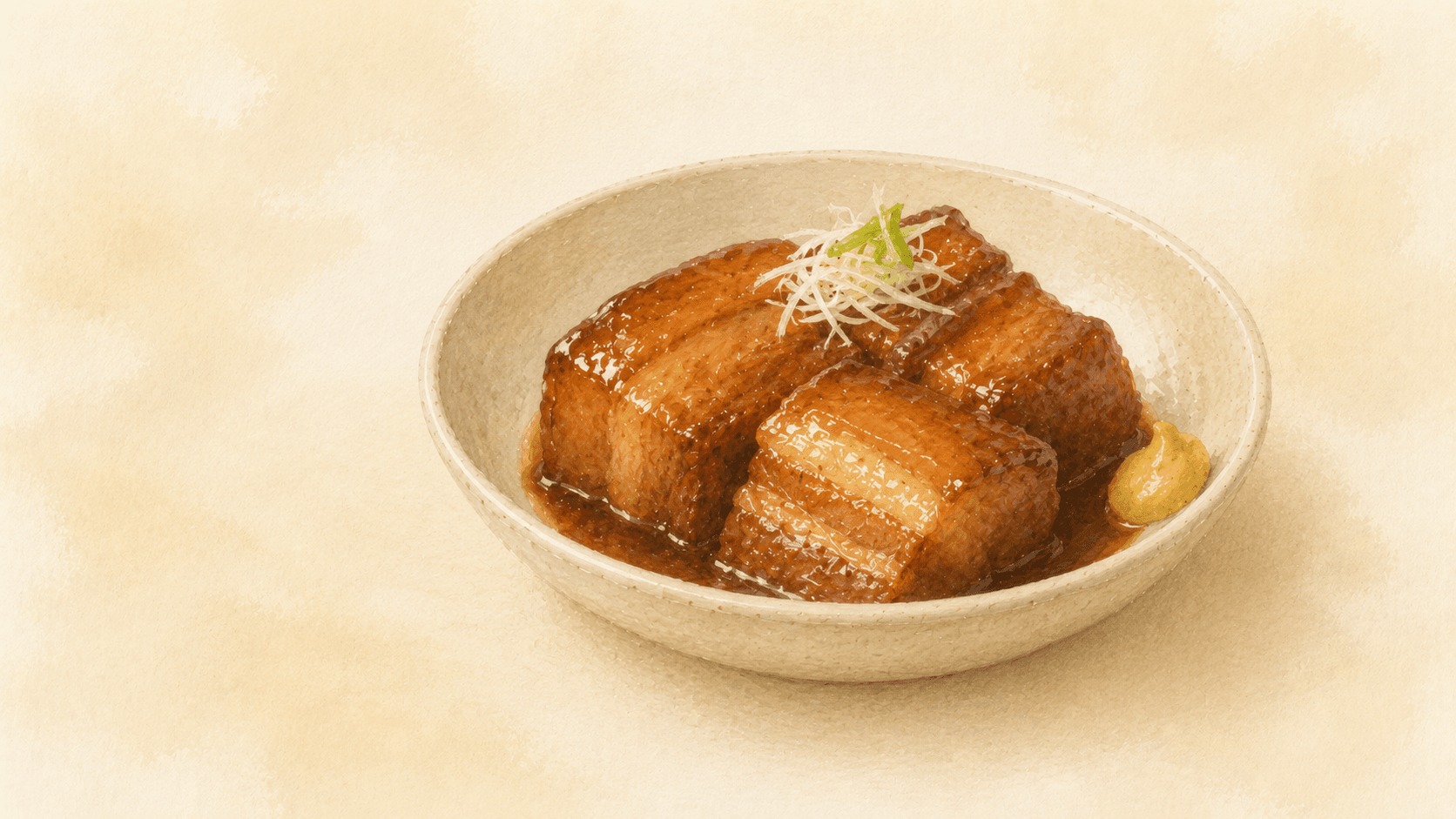
Thick slabs of pork belly braised in soy, mirin, sake, and sugar over several hours until the collagen has dissolved into gelatin and the fat layer has rendered into something that melts rather than resists. Time is the only technique here.
Contents (7 sections)▾
Ingredients
- 800 g pork belly — skin-on, in one piece
- 500 ml water (for parboiling)
- 500 ml water or dashi (for braising)
- 4 tbsp soy sauce
- 3 tbsp sake
- 3 tbsp mirin
- 2 tbsp sugar
- 2 spring onions — roughly chopped (for parboiling)
- 3 cm fresh ginger — sliced (for parboiling and braising)
- 1 spring onion — thinly sliced (to garnish)
- Karashi (Japanese hot mustard) — to serve
Steps
Parboil the pork belly: Place the whole pork belly in a pot and cover with cold water. Add the roughly chopped spring onions and half the ginger slices. Bring to a boil, then reduce to a simmer and cook for 30 minutes. This step removes blood and impurities that would otherwise cloud the braising liquid and give the finished dish a muddy, metallic undertone. Discard the water. Rinse the pork under cold water and pat dry.
Cut the parboiled pork belly into 4–5 cm cubes (kakuni means 'square simmered'). The precise cube shape is a culinary aesthetic choice, but it also ensures relatively uniform cooking times across pieces.
Arrange the pork pieces in a single layer in a heavy-bottomed pot or Dutch oven. Add the braising liquid: water or dashi, soy sauce, sake, mirin, sugar, and the remaining ginger slices. The liquid should come about two-thirds up the sides of the pork. Bring to a gentle simmer over medium heat, then reduce to the lowest possible flame. Cover with a drop lid (otoshibuta) or cut a circle of parchment to rest on the surface — this keeps the pork submerged and the liquid level relatively stable.
Braise on the lowest possible heat for 2 hours. Alternatively, use a pressure cooker at full pressure for 40 minutes. Check occasionally — the liquid should be barely simmering, with small bubbles rising lazily from the bottom. Vigorous boiling will tighten the pork and emulsify excess fat into the liquid in an unpleasant way.
Remove the pork to a plate. Strain the braising liquid through a fine sieve into a clean pan. Skim any fat from the surface (or chill the liquid and lift off the solidified fat). Return the liquid to medium heat and reduce by half to a syrupy glaze, stirring frequently as it thickens. Return the pork to the glaze over low heat and baste constantly for 3–4 minutes until the pork is lacquered and shining. Serve in shallow bowls with the thinly sliced spring onion and karashi on the side.
Why this works
Kakuni (a Japanese braise of cubed pork belly in soy, sake, mirin, and sugar — literally "square simmered") is fundamentally about collagen conversion. Pork belly contains two types of fat — the intramuscular fat that marbles the lean meat, and the thick subcutaneous fat cap. Both behave differently during the long braise, and both require time, not high heat, to transform into something desirable.
The subcutaneous fat layer of pork belly is rich in collagen — a structural protein that at low temperatures is tough and gelatinous. When held at temperatures between 70–80°C (which is what a very gentle simmer produces) for 2 hours or more, the collagen triple helix structure unravels. The individual protein strands hydrolyze into shorter peptide chains — gelatin. This gelatin dissolves into the braising liquid, making it syrupy and thick; and within the fat layer itself, the conversion creates a soft, yielding texture that literally melts on contact with the palate. Pork belly braised at this temperature and time is distinctly different from pork belly that has only been cooked to an internal temperature of 70°C for 30 minutes — the collagen has not had enough time to convert.
The fat cap also renders during the long braise. Rendered fat, unlike unrendered fat, has a clean, neutral richness without the waxy resistance of unmelted lard. This is why kakuni fat is prized rather than trimmed: properly braised pork belly fat is not the same substance as raw pork fat.
The parboiling step is not optional. Raw pork belly placed directly into a sweetened soy braise without prior blanching will release myoglobin (the protein responsible for meat color), blood, and soluble impurities into the braising liquid. These impurities create a cloudy, slightly bitter liquid that produces a muddier finished glaze. A 30-minute parboil with aromatics removes the bulk of these compounds before they can affect the braising liquid.
Sugar and mirin together provide the sweetness that counterbalances the salt of the soy sauce, but they also serve a structural role in the final glaze. As the braising liquid reduces, the sugar concentration increases and the liquid thickens into a lacquer-like coating. This is the characteristic glossy finish of kakuni that distinguishes it from Western-style braised pork.
Common mistakes
Skipping the parboil (下茹で).
Target: Pork belly cubes simmered in plain water for 30 minutes, then drained, before the proper braise.
Why it matters: Without parboiling, the braising liquid becomes muddy and the final glaze loses clarity. Parboil removes blood, surface impurities, and excess fat — the single step with most impact on the finished dish's quality.
What to do: Cover pork in cold water, bring to a simmer, cook 30 minutes, drain and rinse the pork.
Workarounds:
- For deeper cleanup, parboil with ginger slices + green onion tops — masks any remaining pork off-notes.
Braising too hot.
Target: Bare simmer (85 °C) for 2+ hours. Barely any bubbles on the surface.
Why it matters: Vigorous boiling tightens lean muscle fibers before collagen converts — produces dry, tough lean meat with greasy liquid. The slow conversion of collagen to gelatin requires sustained low heat.
What to do: After parboiling, cover with seasoning liquid (dashi + soy + mirin + sake + sugar). Maintain bare simmer. Use a drop lid.
Workarounds:
- Pressure cooker: 45 minutes high pressure approximates 2+ hours conventional. Different texture but workable.
Not reducing the braising liquid.
Target: After the meat is tender, remove pork, reduce the liquid by 50% until it's a syrupy glaze.
Why it matters: Serving pork in thin braising liquid is a common shortcut that misses the dish's signature. The reduction concentrates flavor into a lacquer-like glaze that coats the meat.
What to do: Remove pork carefully. Reduce liquid uncovered. Return pork to glaze, baste to coat.
Workarounds:
- For darker glaze, add 1 tbsp of dark soy sauce during reduction.
Not skimming the fat.
Target: Skim fat from the surface during cooking AND from the final glaze.
Why it matters: Pork belly renders substantial fat. Without skimming, the glaze becomes greasy rather than the silken, lacquer-like coating that defines kakuni.
What to do: During braising, periodically skim. After cooling, the fat solidifies and lifts off — easiest method.
Workarounds:
- For unattended cooking, chill the braising liquid overnight, lift solidified fat off, then reduce.
No accompanying boiled egg.
Target: Hard-boiled egg added to the braising liquid for the final 30 minutes, absorbing flavor.
Why it matters: Kakuni traditionally comes with a soy-stained, flavored boiled egg — the contrast adds visual and textural variety. Without it, the plate looks incomplete.
What to do: Boil eggs separately (7-min jammy), peel, add to braising liquid in the final 30 minutes. Reduce 1 hour after.
Workarounds:
- For deeper color, marinate eggs in soy + mirin overnight separately.
What to look for
- After parboiling: water should be noticeably grey-brown and foamy. This is what is being removed.
- During braising: barely simmering — small bubbles rising slowly. No vigorous movement.
- Collagen conversion indicator: after 2 hours, the skin and fat layer should be visibly soft and yield to gentle pressure. The lean meat should be very tender.
- Finished glaze: syrupy, coating a spoon. Pork should be lacquered and gleaming.
Chef's view
Kakuni requires almost no skill — only time and the discipline to keep the heat low. This is why it is paradoxically harder to cook well than dishes that demand active technique: the temptation to raise the heat and shorten the cooking time is constant, and the penalty for doing so — tough lean meat — is irreversible.
The karashi mustard served alongside is not decorative. Japanese hot mustard (karashi) is sharper and less vinegary than most Western mustards; it cuts through the deep sweetness of the tare and the richness of the fat in a way that brightens the palate for the next bite. This is the same principle as the dab of mustard served with rillettes in French cooking — fat and sharpness are natural counterparts.
Chef Test Notes
Tested braising time at 1 hour, 1.5 hours, and 2 hours. At 1 hour, the lean meat was tender but the fat layer still had distinct waxy resistance. At 1.5 hours, the fat was noticeably softer but not fully converted. At 2 hours, the fat yielded completely and the lean meat had the correct texture. At 2.5 hours, the lean meat was beginning to fall apart — acceptable but less structured.
Tested pressure cooker (40 min) versus stovetop (2 hours). The pressure cooker produced a slightly less nuanced glaze — the liquid had less time to develop complexity — but the pork texture was comparable. A workable alternative when time is short.
Related glossary terms
- Braising — the covered, low-liquid technique used here
- Collagen — the protein whose conversion to gelatin is the central event of the long cook
- Reduction — the glaze-making step at the end
- Maillard reaction — contributes to the dark color of the soy-based glaze
Get the essays in your inbox — free
Weekly notes on flavor, fermentation, and food history — the writing behind the Atlas of Flavor. No spam; unsubscribe anytime.