
Hiyayakko
Cold silken or soft tofu served as-is, with a small selection of toppings and a pour of soy sauce at the table. Hiyayakko is not a recipe in any conventional sense — it is an argument about restraint: how much can be done with cold, fresh protein, good soy sauce, and nothing else.
Contents (7 sections)▾
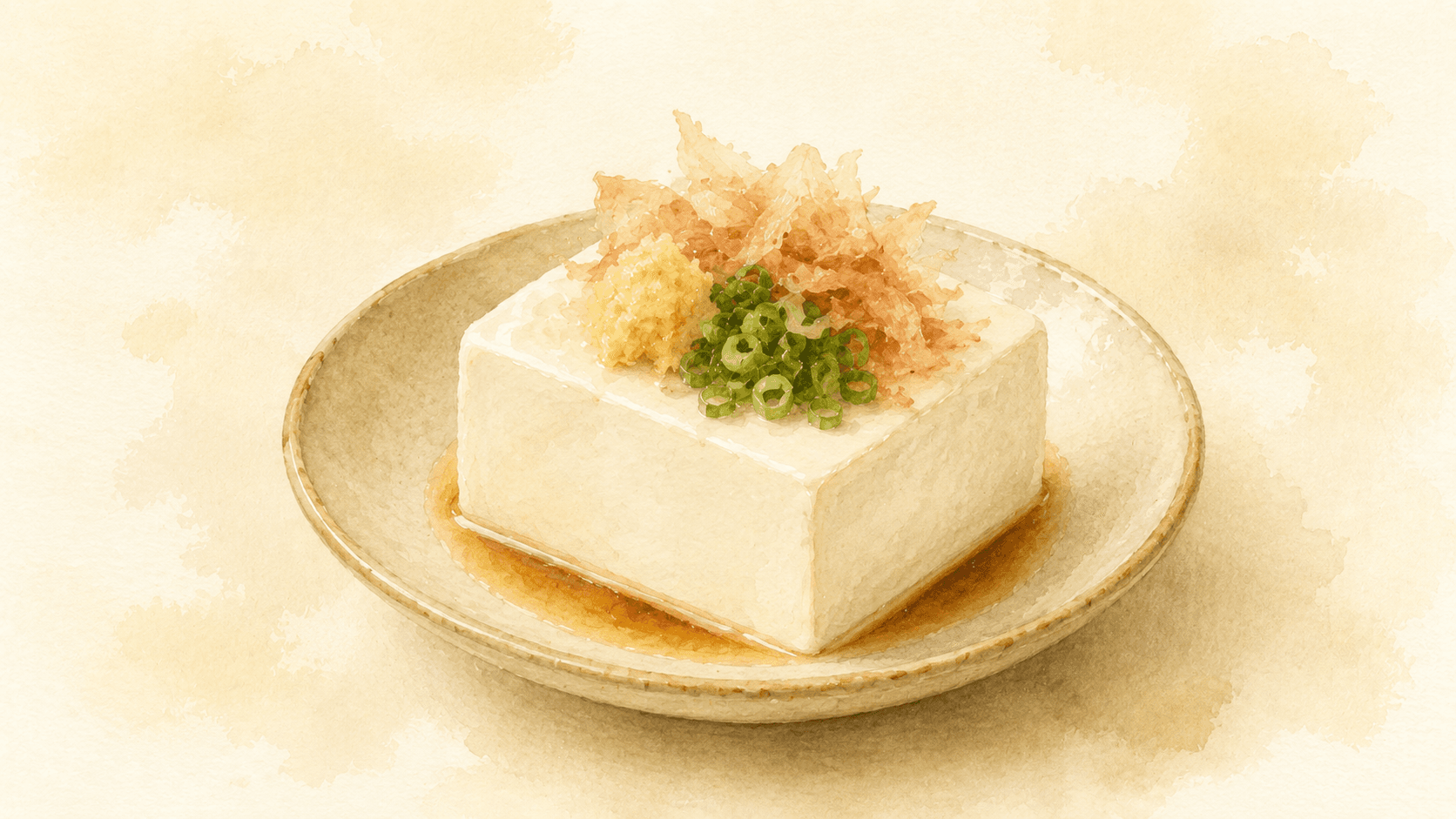
Ingredients
- 1 block (300–400 g) silken or soft tofu — kept cold
- 2 tbsp katsuobushi (bonito flakes)
- 1 tsp fresh ginger — finely grated
- 2 spring onions — thinly sliced
- Good soy sauce — to taste (about 1 tsp per serving)
- Optional: myoga (Japanese ginger bud), shiso, natto, sesame oil
Steps
Keep the tofu refrigerated until the moment of serving. Remove from packaging and drain any water. Cut the block in half for two portions, or into four pieces if serving as a single-bite side. Place on a flat plate or a shallow dish with a slight rim to catch the soy sauce. The tofu should be cold — ideally between 4–8°C at the time of serving.
Arrange the toppings: place a small mound of katsuobushi on top of the tofu, a small amount of grated ginger to one side, and a scattering of sliced spring onion. Other optional toppings can be arranged in small amounts. The toppings should complement the tofu, not cover it — the white surface of the tofu should remain mostly visible.
Serve with soy sauce on the side or pour a small amount directly over the tofu at the table. Soy sauce should be added at the moment of eating, not in advance — pouring soy sauce over tofu and letting it sit draws out moisture from the tofu, dilutes the soy sauce, and produces a puddle that saturates the tofu unevenly. The contrast between the cold, neutral tofu and the warm, salty soy sauce is a deliberate part of the dish.
Why this works
Hiyayakko is structured around a single principle: the best tofu, served cold, requires almost nothing added. Everything about the preparation is in service of that idea.
Fresh silken or soft tofu (kinugoshi or soft momen) is a high-moisture, delicate protein matrix. Its flavor is a subtle blend of soy-derived amino acids, faint sweet nuttiness from the coagulant (typically calcium sulfate or nigari, which is magnesium chloride from seawater), and the clean taste of water. This flavor is genuinely pleasant on its own — it is not bland in the pejorative sense; it is neutral in the way that a good fresh cheese or a mild poached egg is neutral, carrying potential without imposing anything.
The tofu's internal temperature matters. Cold tofu (4–8°C) has a firmer, more cohesive texture than tofu served at room temperature. The protein matrix is slightly contracted at cold temperatures, which gives the silken variety a slight tension at the surface — it yields when pressure is applied but does not immediately deform. This is the texture that makes hiyayakko worth eating as a dish rather than as a neutral filler. Tofu that has been removed from the refrigerator and allowed to warm to room temperature before serving loses this quality.
Katsuobushi (paper-thin shavings of smoke-cured, dried bonito — the savory backbone of Japanese stocks) performs three functions simultaneously. It provides umami (the inosinate from the dried bonito compounds with the glutamate already in the tofu's soy-derived proteins); it provides textural contrast — the thin, dry shards against the smooth, cold, wet tofu; and the heat of soy sauce poured over the tofu causes the katsuobushi to flutter and move, which is a moment of visible aliveness at the table that Japanese aesthetics values.
Ginger is the digestive note — both because its volatile compounds, including zingerone and shogaol, genuinely support fat and protein digestion, and because its sharp heat provides a contrast signal to the brain that differentiates each bite. The standard form is finely grated fresh ginger — the cell-wall disruption from grating releases more of the volatile compounds than slicing.
The soy sauce must be poured at the table, not in advance. This is not ceremony for its own sake. Pre-poured soy sauce draws moisture out of the tofu by osmosis, dilutes itself, and distributes unevenly. The first pour, at the moment of eating, makes contact with cold tofu at its most cohesive — the soy sauce pools briefly before being absorbed, and the eater controls when and where it goes.
Common mistakes
Low-quality or old tofu.
Target: Freshest possible tofu — clean sweetness, firm cohesive texture.
Why it matters: Hiyayakko has nowhere to hide poor tofu — it IS the dish. Old tofu has sour notes, watery flavor, soft texture that breaks during plating.
What to do: Buy from a Japanese grocery on the day of serving. Check the date.
Workarounds:
- Premium → homemade tofu or specialty fresh tofu — significant flavor upgrade.
Serving at room temperature.
Target: Tofu chilled to refrigerator temperature, plate also chilled.
Why it matters: "Hiya" means cold — the chill is integral. Room-temp tofu is softer, less cohesive, prone to breaking. The dish loses its structural rationale.
What to do: Chill tofu and plate. Serve as soon as toppings are applied.
Workarounds:
- For extra cold, place tofu briefly in an ice bath before plating.
Soy sauce poured in advance.
Target: Pour soy sauce at the table — the moment of eating.
Why it matters: Pre-poured soy produces a wet, salted pool that saturates the tofu unevenly. The pour is a moment in eating, not marinating.
What to do: Serve soy sauce separately. Pour just before each bite if possible.
Workarounds:
- For "minimalist" version, salt + a few drops of olive oil instead of soy — clean, modern.
Wrong tofu type for season.
Target: Silken (kinugoshi) tofu for summer (cold, delicate), soft momen for spring/autumn (slightly more body).
Why it matters: Silken tofu is the classic summer choice — the ultra-soft texture suits hot weather. Soft momen has more body for cooler seasons.
What to do: Match tofu to season. Both work — different feel.
Workarounds:
- For premium, oboro tofu (curdled but not pressed) — most luxurious silken texture.
Wrong topping ratio.
Target: Three classical toppings — katsuobushi (bonito flakes), grated ginger, sliced scallion.
Why it matters: Hiyayakko is not the place to apply everything in the fridge. The 3 classic toppings each have a specific function — bonito for umami top note, ginger for sharp clarity, scallion for fresh aromatics.
What to do: Stick to the classics. Sparingly applied.
Workarounds:
- Optional additions: myoga (ginger family), shiso, sesame seeds — for variety, NOT substitutions.
What to look for
- Tofu freshness: clean, slightly sweet smell. No sour notes. Firm, cohesive when cut.
- Cold temperature: the plate and the tofu should feel cold to the touch at service.
- Katsuobushi placement: on top, not pressed in. It should be able to move when soy sauce hits it.
- Soy sauce quantity: a small amount — 1 tsp per serving is sufficient. The tofu should not be swimming.
Chef's view
Hiyayakko is the dish I use to understand a Japanese kitchen's character. In the same way that a bowl of miso soup tells you about how a cook handles dashi, hiyayakko tells you about how a cook values — or fails to value — freshness and restraint. Served with good tofu and poured carefully at the table, it is better than anything that could be done to the tofu by cooking it. The cold, the neutral, the simple — these are not limitations; they are the point.
In Japanese food culture, hiyayakko is specifically a summer dish. The cold tofu is cooling in a practical sense (heat dissipates from the body on contact with cold food), and its light protein content makes it appropriate in heat when heavier dishes are unappealing. In izakayas it appears as a casual order alongside cold beer and grilled items — the contrast of temperatures and textures across a table of small plates.
Chef Test Notes
Tested silken versus firm tofu. Silken tofu (kinugoshi) produced a more delicate, smooth texture appropriate for hiyayakko. Firm tofu (momen) was also acceptable, particularly for eaters who prefer more structural bite — but the mouthfeel is noticeably different, closer to a pressed cheese than to a custard. Both are correct forms of the dish.
Tested tofu temperature: 4°C, 12°C, and 20°C. At 4°C (straight from the refrigerator), the tofu held the best shape and had the tightest texture. At 12°C, slightly softer. At 20°C, noticeably softer and more prone to losing shape when the soy sauce was poured over.
Tested soy sauce timing: poured immediately before eating vs. 5 minutes in advance. At 5 minutes, the soy sauce had drawn out visible moisture from the tofu, diluted itself, and saturated the tofu unevenly. Immediate pour was dramatically better.
Related glossary terms
- Umami — the glutamate and inosinate combination from tofu and katsuobushi
- Coagulation — the nigari or calcium sulfate process that sets tofu's protein matrix
- Osmosis — the mechanism by which pre-poured soy sauce draws moisture from the tofu
Get the essays in your inbox — free
Weekly notes on flavor, fermentation, and food history — the writing behind the Atlas of Flavor. No spam; unsubscribe anytime.