
Crema Catalana
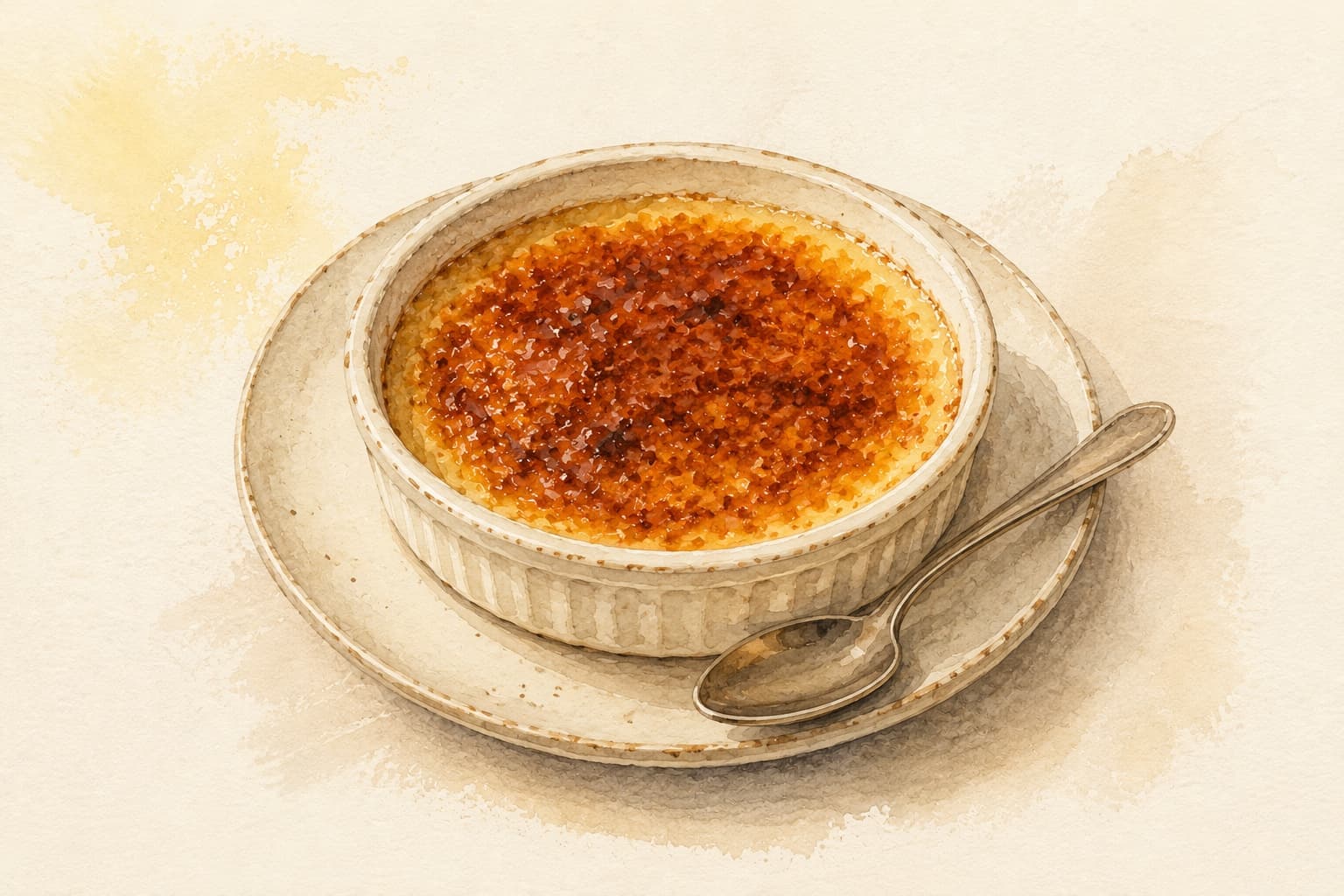
This dessert showcases a delicate balance of creamy custard and caramelized sugar, achieving a contrasting texture and flavor.
Contents (5 sections)▾
Ingredients
- 500 ml whole milk
- 4 large egg yolks
- 100 g granulated sugar
- 30 g cornstarch
- 1 cinnamon stick
- Zest of 1 lemon
- Zest of 1 orange
- Sugar for caramelizing
Steps
In a saucepan, combine milk, cinnamon stick, lemon zest, and orange zest; heat until just boiling.
In a bowl, whisk together egg yolks, granulated sugar, and cornstarch until smooth.
Slowly pour the hot milk mixture into the egg mixture, whisking continuously to temper the eggs.
Return the mixture to the saucepan and cook over medium heat, stirring constantly, until thickened.
Pour the custard into ramekins and chill in the refrigerator for at least 2 hours.
Before serving, sprinkle sugar on top and caramelize with a kitchen torch until golden.
Tools you'll want
- · Digital kitchen scale (gram precision)
Why this works
Crema Catalana relies on precise heating to achieve a smooth custard. The combination of milk and egg yolks creates an emulsion that thickens as it cooks. Cornstarch stabilizes the mixture, preventing curdling. Tempering the eggs with hot milk (warming them slowly with a little hot liquid so they don't scramble) ensures a velvety texture.
The caramel topping forms at high temperatures when sugar melts and then cools quickly. This contrast between the creamy custard and crunchy caramel enhances the sensory experience. A torch allows for controlled caramelization, ensuring an even and appealing finish.
Chilling the custard is crucial. It sets the structure, allowing it to hold its shape when served. The balance of flavors from the citrus zest and cinnamon adds depth.
Common mistakes
Not tempering the eggs.
Target: Add hot infused milk to whisked yolk-sugar mixture GRADUALLY — one ladle at a time while whisking constantly.
Why it matters: Pouring hot milk all at once produces scrambled yolks. Tempering raises the yolks' temperature slowly so they don't coagulate.
What to do: Whisk yolks + sugar in a bowl. Whisk in 1 ladle hot milk → keep whisking → another ladle → repeat until all combined.
Workarounds:
- Scrambled yolks? Strain through fine sieve — saves the dish (less smooth, still passable).
Wrong starch / no starch.
Target: Traditional crema catalana uses cornstarch (about 1 tbsp per portion) as a thickener — distinguishing it from French crème brûlée which uses no starch.
Why it matters: Crema catalana has a slightly firmer set than crème brûlée due to the cornstarch. Skipping it produces a different (French-style) custard.
What to do: Dissolve cornstarch in cold milk before adding to the egg mixture.
Workarounds:
- For French crème brûlée style, no starch — relies entirely on egg yolks for set.
Cooking custard at too-high heat.
Target: Cook over LOW heat, stirring CONSTANTLY. Pull from heat when it coats the back of a spoon — about 80 °C.
Why it matters: High heat curdles yolks. Crema catalana is cooked on the stovetop (unlike crème brûlée baked in oven), so temperature control is critical.
What to do: Heavy-bottomed pot. Wooden spoon. Stir constantly. Watch for coating on the spoon.
Workarounds:
- For more safety, use a double boiler — slower but harder to overheat.
Caramelizing with the broiler instead of a torch.
Target: Use a kitchen torch for even caramelization of the sugar layer.
Why it matters: Broilers cook unevenly — produces dark patches and pale patches. A torch lets you control exactly which spots get more heat.
What to do: Sprinkle sugar evenly. Torch from 5 cm distance, moving constantly until uniform amber.
Workarounds:
- No torch? Broiler works but watch closely — pull when first amber spots appear.
Skipping the citrus and cinnamon infusion.
Target: Infuse milk with lemon peel + orange peel + cinnamon stick for 15 minutes BEFORE making custard.
Why it matters: Crema catalana's defining aromatics come from this infusion. Skipping makes it a plain vanilla custard — fine but not Catalan.
What to do: Heat milk with citrus peels + cinnamon → cover → rest 15 min → strain → use.
Workarounds:
- For deeper flavor, infuse overnight in the fridge — cold infusion extracts differently but well.
What to look for
- A smooth, glossy surface on the custard.
- A firm set that holds its shape in the ramekin.
- An even, golden caramel layer without dark spots.
Chef's view
Crema Catalana is a traditional Spanish dessert, often enjoyed during celebrations. Its roots trace back to medieval Catalonia, where it was originally made with milk, sugar, and egg yolks. The practice of caramelizing sugar on top distinguishes it from other custards like crème brûlée.
The ritual of preparing Crema Catalana reflects the importance of patience and precision in Spanish cooking. Each layer—from the creamy custard to the crackling caramel—highlights the skill required to create a truly memorable dessert.
<!-- beginner-glossed v1 -->Get the essays in your inbox — free
Weekly notes on flavor, fermentation, and food history — the writing behind the Atlas of Flavor. No spam; unsubscribe anytime.