
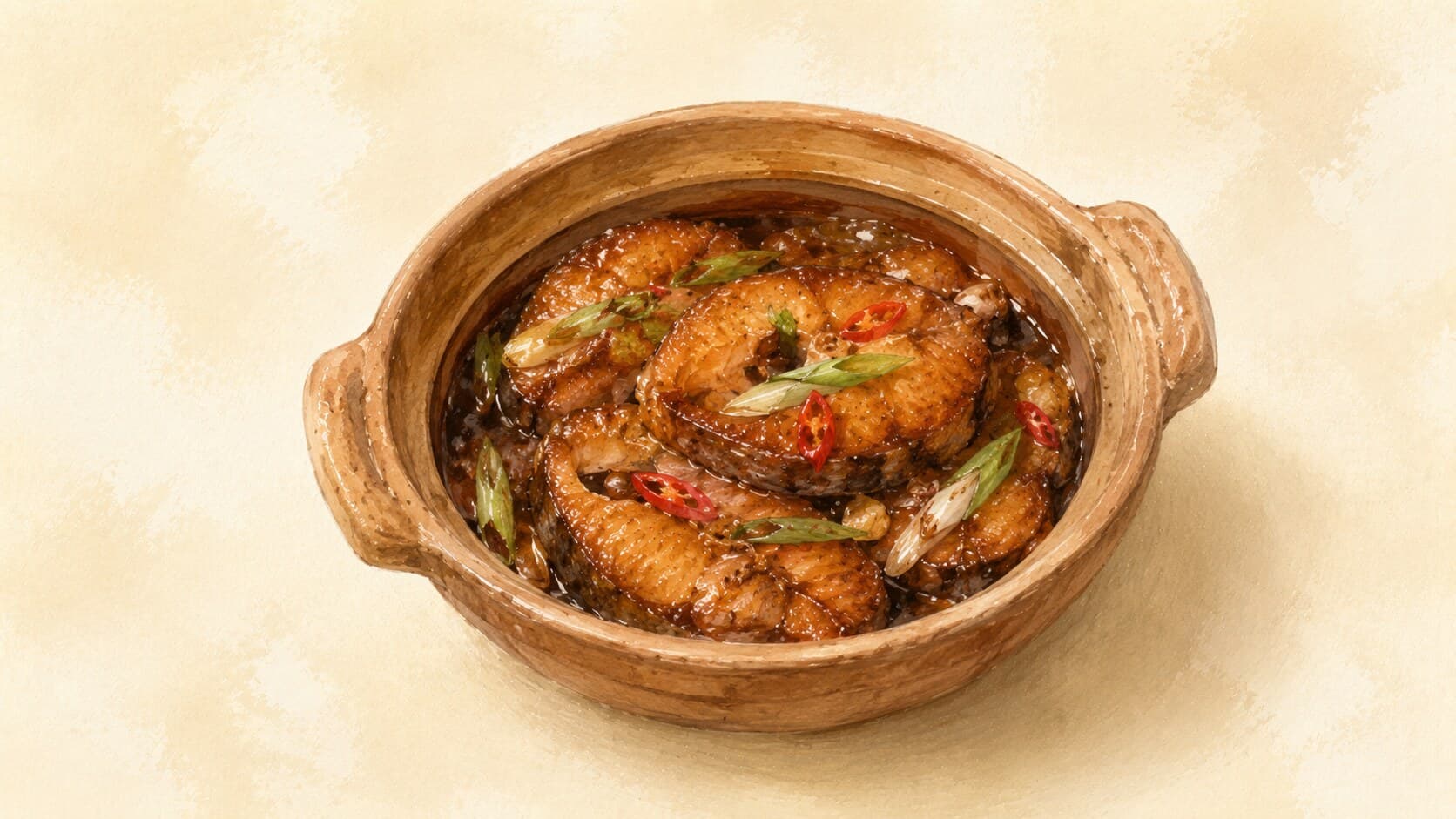
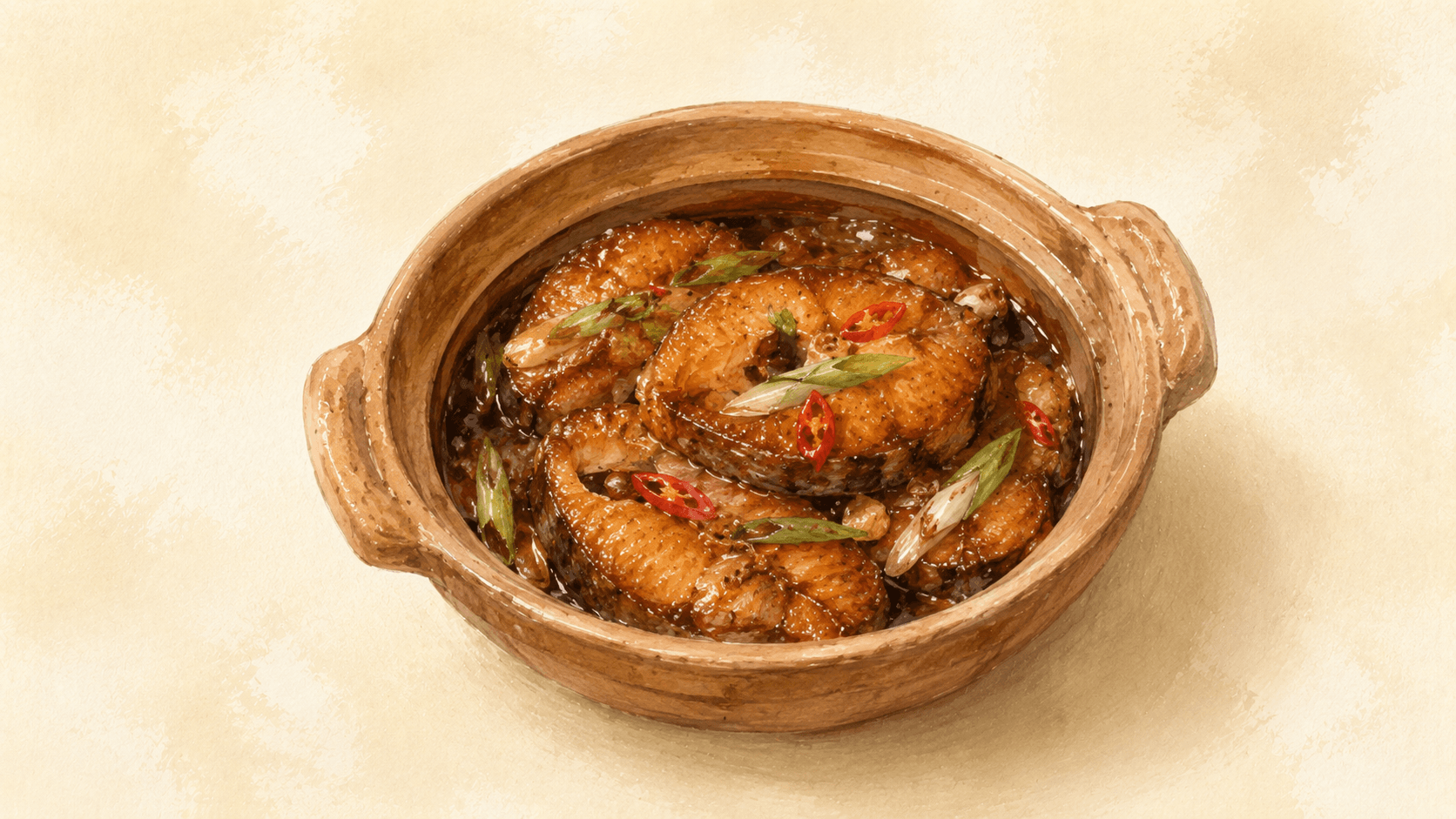
Cá Kho Tộ (Clay Pot Caramelized Fish)
Vietnamese dry caramel is made from white sugar cooked to amber — then deployed as a savory seasoning, not a sweet element. That inversion is the logic of the dish, and understanding it changes how you read the whole reduction.
Contents (8 sections)▾
Ingredients
- 400 g firm white fish — catfish (cá tra or cá basa) is traditional, cut into steaks 3–4 cm thick
- 3 tbsp fish sauce
- 1 tsp black pepper (generous)
- 2 cloves garlic, minced
- 1 shallot, minced
- 100 ml coconut water (young coconut, not coconut milk — cleaner braising liquid)
- 1 tsp neutral oil
- Spring onions and sliced chili to garnish
- **For nước màu (caramel base):**
- 3 tbsp white sugar
- 2 tbsp water
Steps
Marinate the fish: combine fish steaks with fish sauce, black pepper, minced garlic, and minced shallot. Let stand 20–30 minutes at room temperature. The fish sauce will begin to firm the outer layer slightly — this is the salt acting on the proteins.
Make nước màu: in a small heavy-bottomed pan, combine sugar and water. Cook over medium heat without stirring until the mixture reaches amber — the color of iced tea. Watch carefully; the color change from golden to amber to burnt happens in under 30 seconds. Pull off the heat when it reaches amber; residual heat will continue the reaction. Let cool briefly.
In a clay pot or heavy saucepan, heat the oil over medium heat. Add the remaining minced garlic and shallot from the marinade and sauté until fragrant, about 1 minute.
Add the nước màu to the pot — it will spit. Immediately add the fish steaks carefully, presentation-side down.
Add coconut water to come about halfway up the fish. Bring to a strong simmer over medium-high heat.
Cook uncovered over medium heat, turning the fish gently once at the halfway point. The liquid should reduce gradually. Do not rush the reduction with high heat — it will scorch before the fish is cooked through.
The dish is done when the liquid has reduced to a thick, glossy sauce that coats the fish and clings to a spoon — about 20–30 minutes. The surface of the fish should show deep caramelized color. The sauce is as important as the fish. Serve immediately over rice.
Tools you'll want
Why this works
The nước màu is the pivot point of the dish. White sugar heated with a small amount of water undergoes a complex set of reactions — the water evaporates, the sugar melts and begins to undergo pyrolysis, and the sucrose molecules break down into hundreds of new compounds including furanones, diacetyl, and hydroxymethylfurfural. These compounds produce the characteristic bitter-sweet-complex flavor of caramel. Critically, the bitterness intensifies as the caramelization progresses: a light golden caramel is sweet and mild; an amber caramel is bitter-balanced; a dark caramel is predominantly bitter. For nước màu, you want amber — bitter enough to read as savory when combined with fish sauce and pepper, not so dark it overpowers the fish.
The fish sauce adds the second layer of complexity. It is already high in glutamates (umami) and sodium. When combined with caramelized sugar in a hot pan, the amino acids in the fish sauce participate in Maillard reactions with the caramel's residual sugars — a different reaction from the initial caramelization but one that produces even more aromatic depth. This is why the sauce of a well-made cá kho tộ has a mahogany color and a flavor that is more than the sum of its parts: fish sauce alone + sugar alone < fish sauce + caramel reduced together.
Coconut water is specified over coconut milk or plain water for a precise reason. Coconut water contains natural sugars (glucose, fructose) and electrolytes that contribute to the sauce body as it reduces without adding fat or the heavy sweetness of coconut milk. The result is a lighter braising liquid (the seasoned liquid the fish slowly cooks down in) that produces a cleaner glaze. Plain water works but produces a thinner, less complex sauce. Coconut milk produces an opaque, fatty sauce that overwhelms the fish.
Common mistakes
Burning the caramel.
Target: Amber color — like dark iced tea. ~15 seconds window between amber and burnt.
Why it matters: Light golden = too sweet, one-dimensional. Amber = bitter-balanced, complex. Burnt = acrid, ruins the dish. The kho's character lives in the amber window.
What to do: Medium heat, watch constantly from first color change. Pull off heat at amber — residual heat continues the reaction.
Workarounds:
- Stove control poor → use lower heat and slightly longer time; safer than fast/hot.
Using coconut milk instead of coconut water.
Target: Young coconut water — clear, thin, slightly saline. NOT coconut milk.
Why it matters: Coconut milk = fat + tropical sweetness, opaque pale sauce that overwhelms the fish. Coconut water = clean braising liquid that reduces without dominating. The visual difference is unmistakable: water is clear, milk is white.
What to do: Read the label. "Coconut water" carton = correct. "Coconut milk" can = wrong.
Workarounds:
- No coconut water → plain water works (slightly thinner sauce, longer reduction needed).
Stirring the caramel.
Target: Don't stir the nước màu. Swirl the pan gently if needed for even heating.
Why it matters: Stirring sugar syrup re-seeds with crystals — mass crystallization, syrup seizes to a white solid. Once seized, you have to start over.
What to do: Swirl, don't stir. Keep spoon out of the pan until caramel is finished.
Workarounds:
- Uneven heating → small heavy-bottomed pan distributes heat better than thin one.
High heat for the reduction.
Target: Medium heat for 20-30 minutes. Liquid reduces gradually.
Why it matters: High heat = rapid evaporation = scorched bottom before fish is cooked. Fish gelatin (the natural substance from fish that gives a sauce silky body) needs slow integration into the sauce for body. Rushed reduction = thin watery glaze.
What to do: Steady medium heat. Trust the time — don't rush.
Workarounds:
- Sauce reducing too slowly → uncover (if covered), raise heat slightly (not high).
Overcooking the fish.
Target: 20-30 minutes reduction window. Fish just-cooked, opaque to center, firm but not dry.
Why it matters: Extended cooking = dry crumbling fish. The dish's success requires fish and sauce reaching their endpoints simultaneously.
What to do: If sauce reduces before fish cooks, add splash of coconut water and continue. Don't sacrifice fish texture for sauce thickness.
Workarounds:
- Sauce reduced too far → add a tablespoon of fish sauce diluted in water to thin and restart reduction.
What to look for
- The nước màu color: Amber — the color of dark iced tea, not pale gold, not dark brown. Hold the pan up to a light source to check the color against white.
- The sauce consistency: It should coat the back of a spoon and not run off immediately — a clingy, glossy consistency, not watery.
- The fish surface: Deep caramelized color on the presentation side — the mahogany tone comes from both the nước màu and the fish sauce Maillard products.
- The aroma at the reduction stage: Sweet-savory, almost smoky — not sharp or acidic. If it smells sharp, the caramel has pushed too far toward bitter.
- The sauce volume: Should be reduced to just covering the bottom of the pot — not pooling deeply around the fish, not absent. The fish should be sitting in a thick layer, not swimming.
Chef's view
The thing that took me time to understand about nước màu is that it is a savory tool being deployed on the back of what Europeans treat as a pastry technique. Caramel in a French kitchen shows up in crème caramel, tarte Tatin, salted caramel — desserts. The idea of cooking white sugar to amber and then pouring it over fish in fish sauce is a category jump that requires recalibrating what "sweet" means in a dish. In cá kho tộ, the sweetness is a structural element that balances the salt and umami, not a flavor note in its own right. You should not think "this is sweet" when eating it. You should think "this is deep."
I also think the clay pot matters more than people allow. There is something in the way a clay pot distributes heat — slightly more diffuse, with more thermal mass — that produces a more even reduction than a regular saucepan. The difference is not enormous, but over a 30-minute reduction it accumulates. The traditional vessel is traditional for a functional reason.
Chef Test Notes
Test 1 — caramel darkness. Three batches: light golden nước màu, amber nước màu, and dark brown nước màu. The light golden version produced a noticeably sweeter, milder sauce — less complex, more one-dimensional. The amber was the working version — properly bitter-balanced, complex. The dark brown version was acrid and overpowered the fish; unacceptable. The target is amber with no ambiguity.
Test 2 — coconut water vs. plain water vs. coconut milk. Coconut water produced the best-balanced, cleanest glaze. Plain water worked but produced a thinner sauce requiring longer reduction. Coconut milk produced an opaque, fatty sauce with a sweetness that fought with the fish sauce rather than supporting it. Coconut water is correct.
Test 3 — fish cut. Thick steaks (3–4 cm) versus thin fillets (1.5 cm). Thin fillets cooked through in 10 minutes, leaving 15+ minutes of reduction without fish benefit — they became dry and disintegrated at the edges. Thick steaks held through the full 25-minute reduction window and remained moist at the center while developing color on the outside. The thick steak cut is a functional specification, not an aesthetic preference.
A note from HCMC
Cá kho tộ in HCMC is a weeknight staple — the clay pots come in all sizes, from individual serving pots to family-sized vessels. The smell of fish sauce and sugar caramelizing together rises through apartment buildings in the late afternoon and you know exactly what is happening two floors above you. It is one of the most specific smells of a Vietnamese home kitchen, and it does not exist anywhere else.
Related glossary terms
- Nước màu — Vietnamese caramel sauce made from sugar cooked to amber; used as a savory colorant and flavor base, not a sweet element.
- Kho — the Vietnamese braising technique that reduces a seasoned liquid to a concentrated glaze around the protein.
- Maillard reaction — the browning reaction between amino acids and sugars that produces the mahogany color and complex flavor of the kho sauce.
Get the essays in your inbox — free
Weekly notes on flavor, fermentation, and food history — the writing behind the Atlas of Flavor. No spam; unsubscribe anytime.