
Asparagus with Hollandaise
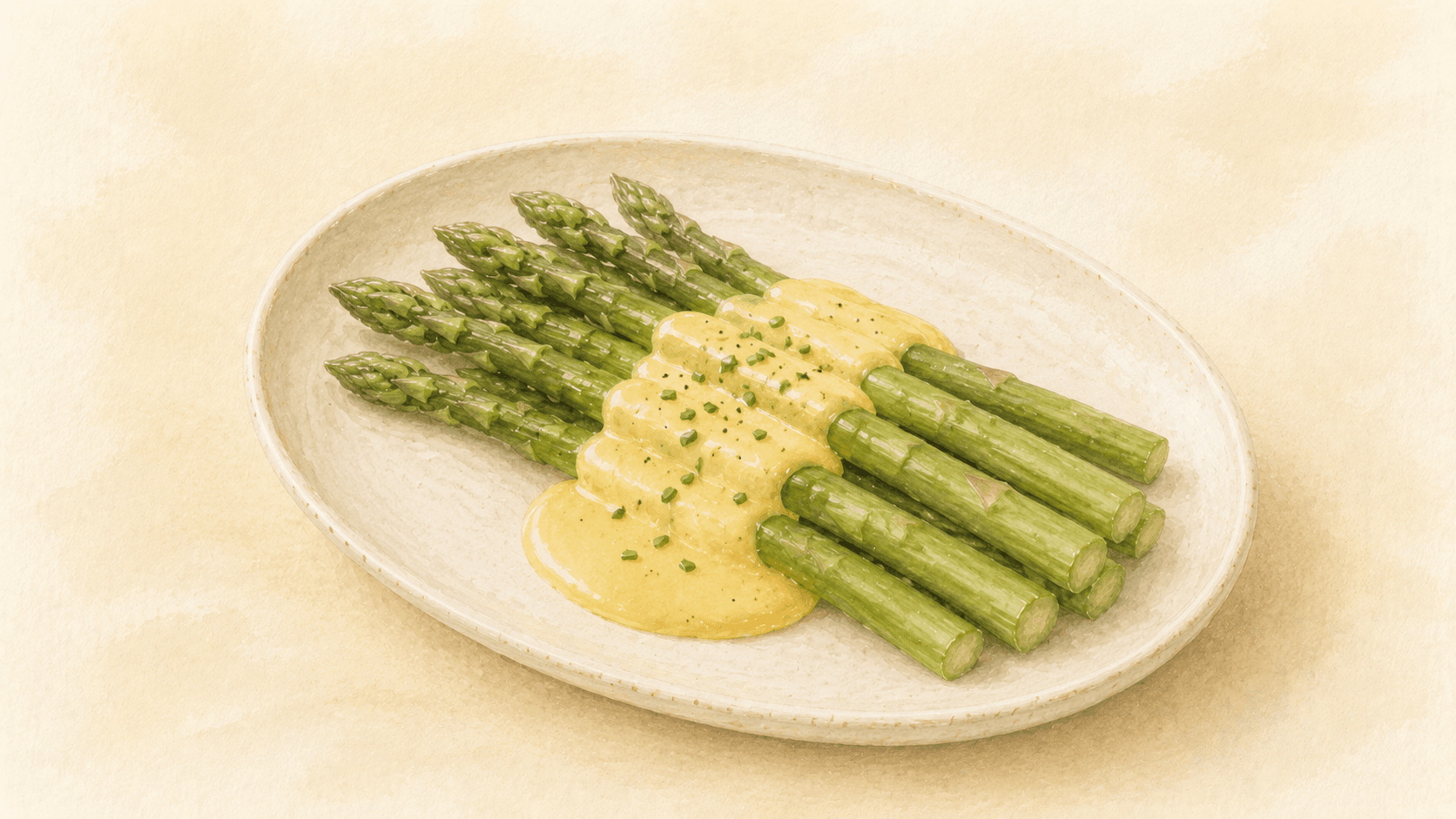
Asparagus cooked until just tender, served warm with hollandaise poured over. This is one of the simplest ways to understand hollandaise — the sauce exists to lift the asparagus, not to compete with it.
Contents (7 sections)▾
Ingredients
- 500 g fresh asparagus — tough ends snapped off
- For the hollandaise: 3 egg yolks (pasteurized, or from shell eggs treated to destroy Salmonella — see the safety note), 200 g clarified butter (warm), juice of ½ lemon, salt, white pepper, 2 tbsp water
- Salt for cooking water
Steps
Cook the asparagus: Bring a wide pan of well-salted water to a full boil. Add the asparagus in a single layer and cook for 3–5 minutes depending on thickness — until a knife tip passes through the thickest part with slight resistance. Thin spears (pencil asparagus) need 3 minutes. Standard green asparagus needs 4–5 minutes. Drain immediately and keep warm. If the hollandaise is not yet ready, the asparagus can be refreshed briefly in warm water to maintain temperature.
Make the hollandaise: Whisk the egg yolks with 2 tablespoons of water in a stainless steel bowl. Place the bowl over a pan of barely simmering water (bain-marie) — the base of the bowl must not touch the water. Whisk continuously, moving the bowl on and off the heat if necessary to control temperature. The mixture should gradually thicken to a thick foam — the ribbon stage, where the whisk leaves a visible trail in the mixture. This takes approximately 4–6 minutes.
Remove from heat. Begin adding the warm clarified butter drop by drop while whisking constantly, gradually increasing to a thin stream as the emulsion establishes. If the mixture becomes too thick at any point, add a few drops of warm water. Season with lemon juice, salt, and white pepper. The finished sauce should be thick enough to coat a spoon and flow slowly when poured — not stiff, not liquid.
Plate the asparagus spears on warmed plates. Spoon the hollandaise over the center section of the asparagus, leaving the tips and cut ends visible. Garnish with finely snipped chives and a light grinding of black pepper. Serve immediately — hollandaise does not hold for long.
Why this works
Hollandaise is an emulsion (a smooth, stable mix of fat and water-based liquid that would normally separate) of clarified butter (butter that has been melted so the pure golden fat can be poured off from the milky solids and water) into egg yolk, acidulated with lemon. The mechanism is identical to mayonnaise in principle, but different in two crucial ways: the emulsifying agent is egg yolk's lecithin (a natural substance in egg yolk that lets fat and water hold together instead of splitting apart), as in mayonnaise; but the temperature of operation is significantly higher (the sauce is made warm), and the fat is liquid butter rather than oil. These two differences make hollandaise more technically demanding than mayonnaise.
The egg yolk must be partially cooked before butter is added — this is the bain-marie (a gentle water-bath setup: the bowl sits over a pan of hot water so the heat reaches it indirectly) stage, where the yolks are whisked to the ribbon stage (thick enough that the trailing whisk leaves a ribbon-like trail on the surface). This partial coagulation (the proteins firming up slightly as they warm, the way an egg sets as it cooks) of the yolk proteins serves two functions: it increases the viscosity of the base before butter is added (which helps the emulsion form more easily); and it produces a slightly cooked, gentle richness rather than the raw egg flavor of an uncooked base. The temperature target is approximately 65–70°C — above 70°C, the yolks can start to scramble.
Safety — the egg yolks. The yolks are only lightly cooked to the ribbon stage; this 65–70 °C emulsion window is a texture target, not a validated pasteurization step, and a warm bain-marie without a controlled, measured hold is not a home Salmonella kill guarantee. For reliable safety — and especially for pregnant people, infants and young children, older adults, and anyone immunocompromised — make the hollandaise with pasteurized egg yolks, or yolks from shell eggs pasteurized in the shell to destroy Salmonella (an ordinary "fresh" egg is not the same thing). The technique is otherwise unchanged.
Clarified butter is used rather than whole butter for a specific reason. Whole butter contains water (approximately 15–18%) and milk solids in addition to the fat. If whole butter were added, the water content would dilute the emulsion and make it less stable; the milk solids would cloud the sauce. Clarified butter, which is pure fat, disperses into the egg yolk more predictably and produces a cleaner, more stable result.
The lemon juice serves as both acid and flavor. In terms of emulsion chemistry, the acid protons help prevent the fat droplets from coalescing — the slight charge disruption from the pH change helps maintain dispersion. The flavor balance of hollandaise — rich, buttery, barely lemon-forward — is what makes it appropriate for asparagus. The acid prevents the sauce from tasting purely fatty.
White asparagus, the French and European preference, is blanched and requires slightly longer cooking than green asparagus because of its denser texture and the need to peel the outer fibrous skin. Green asparagus is the more common form in other markets.
Common mistakes
Too much heat on the bain-marie.
Target: Water barely simmering — surface dimpling, not bubbling. Bowl temperature stays 65-70°C.
Why it matters: Vigorous boiling drives the bowl past 75°C — yolks scramble before the emulsion forms, leaving you with sweet egg curds rather than sauce. Once scrambled, there's no recovery.
What to do: Adjust burner to lowest setting that maintains a steady simmer. Lift bowl off heat for 5-10 seconds whenever the whisk feels too hot or yolks start to thicken too fast.
Workarounds:
- No bain-marie discipline? Try off-heat method: keep the saucepan of hot water on a folded towel beside the stove, dip the bowl in and out — more forgiving than direct positioning.
Adding butter too quickly.
Target: Drop by drop for the first 1/3 of butter. Gradual thin stream after the emulsion is visibly established.
Why it matters: Adding butter faster than the yolks can absorb it = excess free fat = emulsion can't form = broken sauce (the fat has separated out into greasy pools instead of staying blended). Once broken, you're rescuing rather than building.
What to do: Squeeze bottle or pourable spout for controlled drip. After 50-60 ml is incorporated and the sauce is visibly thickened, you can stream slightly faster.
Workarounds:
- Broke? Rescue method: in a clean bowl, whisk a fresh pasteurized yolk with a teaspoon of warm water until pale, then drizzle the broken sauce in slowly as if it were fresh butter.
Overheating the finished sauce.
Target: Hold at 55-60°C maximum. Above 65°C the sauce will break during holding.
Why it matters: Hollandaise is a temperature-fragile sauce — too cool, the butter solidifies; too hot, the emulsion separates. The holding window is narrow.
What to do: Set finished sauce over a warm-water bath (not simmering). Whisk every few minutes to keep the temperature even.
Workarounds:
- Best practice → make hollandaise just before serving, not in advance. Hold 15-20 minutes max.
Using unsalted lemon juice.
Target: Salt to taste with the lemon juice — bright but not flat, balanced acid and salt.
Why it matters: The emulsion is a fat-and-egg vehicle for flavor — under-salted hollandaise tastes flat, greasy, fatty. Salt is what makes the butter and lemon punch through.
What to do: Taste before plating. Adjust salt and lemon together — they balance each other.
Workarounds:
- Over-salted → add more lemon and a teaspoon of warm water to rebalance.
Asparagus over- or under-cooked.
Target: Knife tip passes through the thickest part with slight resistance. Bright green, not olive-drab.
Why it matters: Under-cooked = squeaks against the knife, fibrous. Over-cooked = limp, gray-green, soaks up sauce and turns it watery. Asparagus has a narrow optimal window.
What to do: Standard green asparagus = 4-5 min in well-salted boiling water. Test the thickest spear with a knife. Drain and serve immediately.
Workarounds:
- Plan-ahead → shock in ice water at the exact moment of doneness, then reheat in warm salted water for 30 seconds before serving.
What to look for
- Ribbon stage (yolks before butter): thick, pale foam. Whisk leaves a visible trail that holds for several seconds.
- During butter addition: the sauce should remain thick and smooth. If it begins to look oily, the emulsion is starting to break — stop, add a teaspoon of cold water, and whisk vigorously.
- Finished sauce: pale yellow, thick, pours in a slow ribbon. Tastes buttery, bright, and lightly acidic.
- Asparagus doneness: bright green, slight resistance when pierced. Not soft throughout, not squeaking against the knife.
Chef's view
This combination — white or green asparagus with hollandaise — is one of the most unambiguous seasonal dishes in the French repertoire. It appears in spring and only in spring, when asparagus is at its best, and the simplicity of the preparation means the quality of the asparagus is fully exposed. Hollandaise does not hide mediocre asparagus; it amplifies whatever character the vegetable already has.
The classical serving format is asparagus laid flat on a warm plate, hollandaise spooned over the center. Some restaurants add Jambon blanc (cooked ham) alongside the asparagus, which produces a more substantial first course. Others garnish with a poached egg, which is the move from asperges hollandaise toward a Flemish preparation. All of these are appropriate; none is more correct than the simplest version.
Chef Test Notes
Tested asparagus cooking times: 2 minutes produced asparagus with an audible squeak of the interior under the knife — underdone. 4 minutes for standard green asparagus (8–10 mm diameter at the base) produced the correct tender-firm texture. 6 minutes was soft throughout — acceptable for white asparagus but too soft for green.
Tested with whole butter versus clarified butter. Whole butter produced a sauce that was slightly less stable and had a faint milky note. Clarified butter produced the cleaner result. Beurre noisette (brown butter) in place of clarified is a more complex variation — the Maillard-browned milk solids add nuttiness that pairs well with the asparagus.
Related glossary terms
- Emulsion — the fat-in-water dispersion mechanism that creates hollandaise
- Bain-marie — the indirect heat technique for controlling yolk temperature
- Clarified butter — the pure butterfat used in the emulsion
- Lecithin — the phospholipid in egg yolk that acts as the emulsifying agent
Get the essays in your inbox — free
Weekly notes on flavor, fermentation, and food history — the writing behind the Atlas of Flavor. No spam; unsubscribe anytime.